Dear parents, do you have a child in year 6 or year 2?
I’m sure their teacher must have told you about their upcoming SATs test.
Children In year 2 and year 6 will soon be sitting for SAT tests in school.
So today I would like to share some tips for helping them at home to prepare them for the SAT test
Read with them daily for 10 minutes. Encourage your child to keep reading daily. Discussing the book, the characters and the storylines will help them in their test.
Play mental games with them at home. Games like UNO, Monopoly and Dominoes will help them with math
Practice past Sat test papers with them at home. You can get free past papers on http://www.Gov.uk.
Remember to always praise them for their hard work and effort.
Please don’t force them to study when they are tired because children learn best when they are relaxed.
In addition please don’t wait for exams or tests before you support your children at home. Make learning part of your routine at home. Children who get support at home do way better at school.
If you’re too busy, you can send them to us, we can help you prepare them for the test
Visit our website for more information on how to register your child.
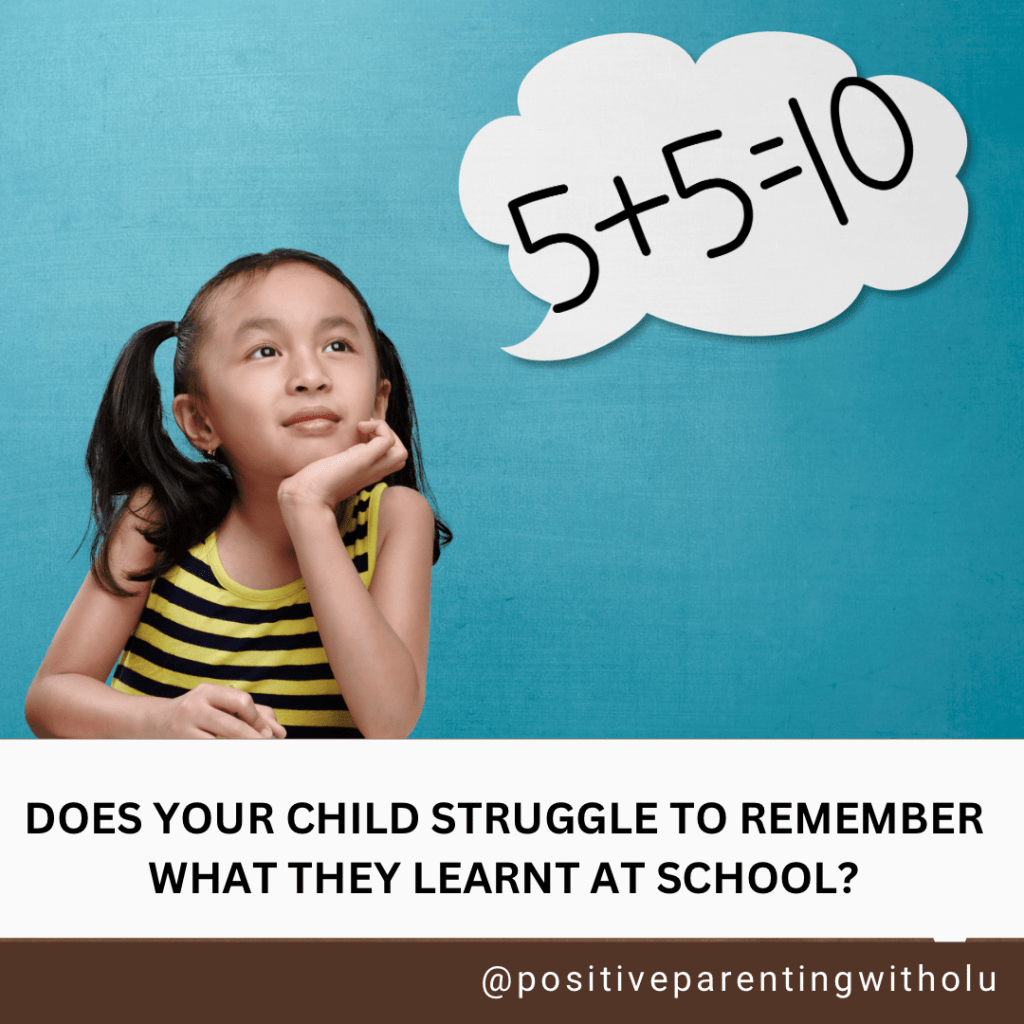
Some parents complain to me that their children don’t remember things.
So today I’m going to share some tips on how to help your children remember things they have learnt.
From my experience as a teacher, I notice that children tend to forget things that they do not practice often.
So one of the things I do with my students before I teach them a new topic is to go over the previous learning so that they can remember what they’ve learnt before, before teaching them new topics.
HERE WE GO👇
When your child returns from school each day you can ask your child what they learned in school each day.
By asking them what they learn you are helping them to recall their experience in their head and then put it in words.
Repetition is key: Another way you can help your child remember stuff is by going over what they learnt previously with them.
If your child can’t remember then you can speak to their teacher and ask them yourself. Most teacher will be happy to share this with you.
When you’re engaged with your child’s learning, they are more enthusiastic about their education and want to make you proud.
No matter how small or big their achievement that day / shows that you care.
The other thing you can do is to break tasks into smaller, manageable chunks and use pictures.
For example:
Let’s say you are trying to teach your child how to spell -(anger, television or cycle …)
You can break up the word anger into an/ger, television into te/le/vi/sion, and cycle into cy/cle.
You can also play memory games as a fun way to sharpen their memory (examples of free online memory games are;
If all this does not work, get him tested for a learning disability.
Remember, every child is different, and what works for one might not work for another. It’s all about finding the strategies that best support your child’s needs.
Children are more capable than we think. So it’s time to prepare our children for the big world with some big life lesson.
Here are some three life skills that you can teach your children before they turn 10.
Money matters: raise a smart consumer by helping them compare prices. For example, at the supermarket ask them to find the least expensive cereal brands.
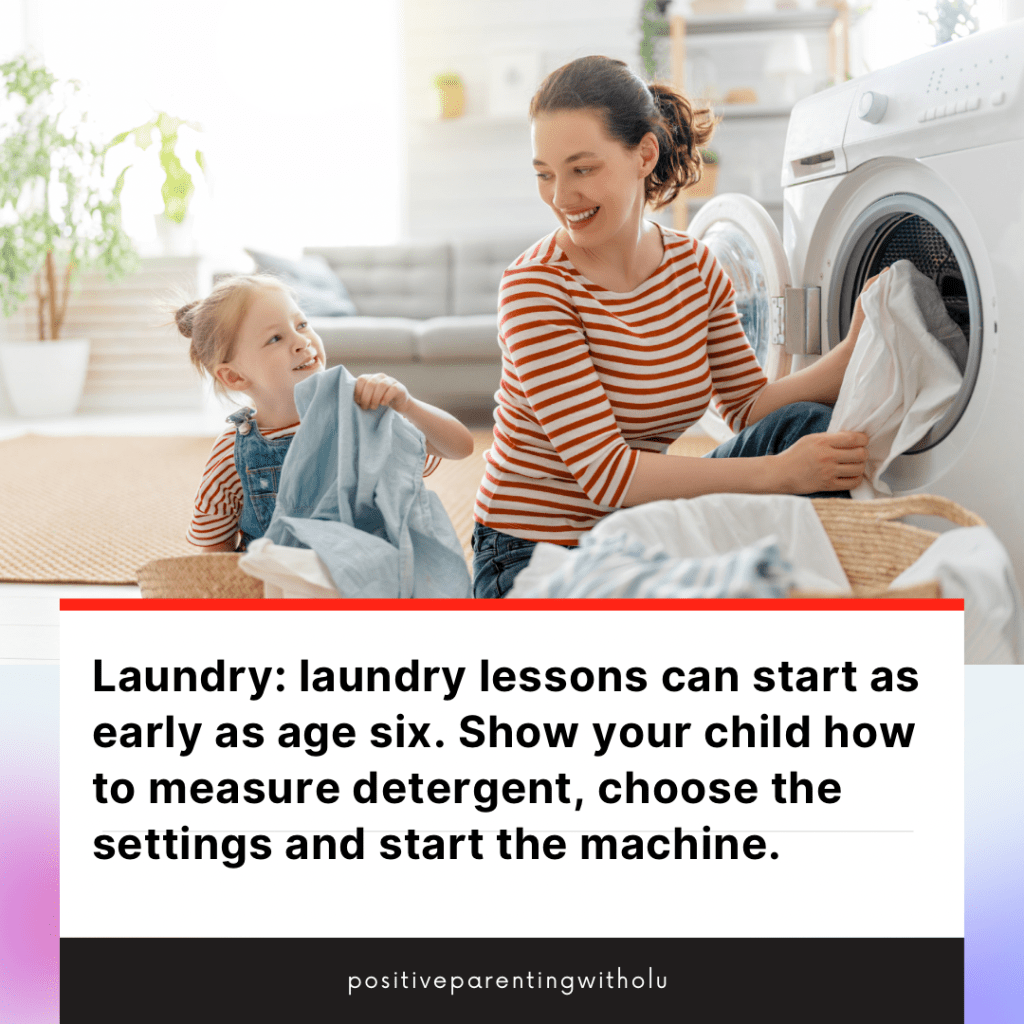
Laundry: laundry lessons can start as early as age six. Show your child how to measure detergent, choose the settings and start the machine.
Cooking: let them prepare a simple meal. Kids as young as 4 can spoon yogurt into a bowl and cut fruits 🍒
FREE COMPUTER CLASSES FOR ADULTS AND THE ELDERLY IS FREE face-to-face learning for beginners, helping you develop digital skills to make the most of the online world.
The internet can save you time and money, and allow you to do more of the things you like doing best.
If you have any questions or if you need help in learning how to use a computer, tablet or laptop
Then Join us every Tuesday at our learning centre to get you started.
Happy Tuesday parents, I trust you are all well. 😊❤️
As parents, we want our children to listen to us, show us respect, and follow our rules.
However, for children to feel willing to listen to us, they need to feel a strong connection with us first.
When your child is behaving in challenging ways, it’s important to remain calm and respond calmly.
Children feel safe when they have a connection/bond with the adults that are taking care of them. They can play and explore the world without the fear of being left or scolded because of something they have done. They know they are loved.
So before I share some tips on how to connect before you correct your child, I would like to give an example that may help you understand.
As an adult, I want you to think back to when you knew you did something wrong and someone told you off, how did you feel?
Ok, let’s look at this scenario: 👇
Let’s say you are at work and one of your jobs is to send and reply to emails or whatever your job entails.
One day you made a mistake and you kind of know and you were trying to rectify your mistakes, but you can’t at that time. It might be because it’s a new job and you don’t know a lot yet.
And every day your boss comes in to remind you that you fail again at your job, and probably say things like this to you.
– “Why do you always make this kind of mistake every day if you’re not going to sit tight and learn this well, I may have to sack you”
Does that negative feedback help?
The answer is No!
it doesn’t help at all!
All you feel at that moment is anger, and you may also feel like punching your boss. Right?
At that time, you’ll be like, “I already know that I made a mistake and I don’t need you to come and tell me this every day! And if you keep pointing out my failure, I’m going to resist you more, right?
But, if you have a thoughtful boss, that believes in you, he may offer you some solutions on how to do your job well next time.
So, as an adult, you wouldn’t like anyone to always point out your mistakes.
Then why are we doing that with our kids?
Children will listen more when you connect with them first before you correct them.
Your kids already know that they fail at something, they don’t need you to tell them, over and over again, especially teenagers.
I remember when my son was in secondary school and he would come home with bad grades and I would say things like “OMG I knew you were going to fail that test because you didn’t study” (☹️)
But later, I learnt to connect with him first before correcting him and it works.
So when he brings home bad grades, I will say to him “That must be so disappointing to have done so poorly on the test and I will then suggest a plan that we can work on together so that he can do better next time.
I must say it was when I started connecting with him before correcting him, that he started listening more.
So, as parents, I think we should be the ones inspiring our children because remember people who make a difference in our lives, inspire and believe in us. I think we should be like that with our kids.
HOW DO YOU DO THIS:
Any time your child makes a mistake or does something wrong, you’re going to start by connecting before you correct.
You’re going to start by talking about What is going right with them at that moment before you start talking about how what they can do better next time.
HERE ARE 3 STEPS TO TAKE WHEN YOUR CHILD MADE MISTAKES.
Only talk to them when both of you are calm!
Share with them what went right.
Tell them you believe in them, talk to them about how confident you are of them that you know they will do better next time and that they have the potential to be successful in whatever they put their heart to.
3. Next is to create a plan with them so that they can do better next time.
Parents, if you follow through with these steps every time your child makes a mistake, they will begin to see you as someone who inspires them to do better instead of someone who will punish them and tell them what they already know.
Where I work there is a high population of senior citizens. In a week, one or two elderly people will walk into our learning centre and ask me to help them do one thing or the other on their phones. I have also noticed some of them at the library struggling with their mobile devices.
I think there is a need! So I wonder if I could create a solution.
So this month I have decided to organize free computer classes for older adults who want to improve their computer skills or want to learn some basic skills on how to use their phones to do online shopping or how to do online banking, or send email and many more things on the internet.
This clases is nothing fancy, it’s just me supporting small groups of 3 to 5 older adults in a very friendly environment.
Just come as you are and bring your laptop or phones and I will show you how to use them properly.
This is difficult to answer as all children are different. In my previous post, I suggested rewards, identifying learning styles and offering assistance.
Today I’m going to use my son as an example to illustrate my point.
My son, while a good kid, was a lousy student! (Please don’t tell him o 😆)
I would get calls from his teachers once a week when he was in secondary school. I knew then he was in some kind of trouble.
He wanted to play football but the team had grade requirements. He didn’t meet them.
I tried offering tutors, suggested he ask for help from teachers, threatened and begged.
When he was in year 10 I stopped talking to him about studying.
But I never took football out of the equation because I felt the work ethic and commitment it required was important for him. He needed (or maybe I needed for him) to be passionate about something. He needed something to feel good about, especially since his older siblings had good grades when they were in school.
I, as a mom, made sure he knew I was there to support his achievements. I tried my best to go to his football games.
What I didn’t do is ask him if he had homework, or tests, or exams. I stopped because he needed to learn to do things without his mom nagging him. When he talked about uni, I simply said “You’re not going to uni Tolu”. He would say to me “Wow Mom, way to be supportive”. 😆
I had to sit back and watch my son flushed his future away because of laziness.
Fast forward a year and a half from graduating sixth form school and he has finally got it.
I don’t know what really brought the change in him.
He started by setting himself a one year goal and he achieved almost everything he wrote down.
He passed his driving test at 17 and he started going to property events learning about Real Estates and property development.
He also learn public speaking and communication skills
He bought lots of books on Property Development management, he did some online courses on property management and he reads books on property management almost every day, self educating himself on property.
He once told me that he reads books on property and real estate because that’s what he is interested in learning.
He did a year apprenticeship in an estate agent company. He worked his ass off in this company.
He now works as a sales representative in one of the biggest Property Companies in London.
He is more focused and disciplined now than ever.
He goes to gym every day, writes blogs and does YouTube videos on how to be a sales representative.
He organized a charity event for his friend and more than 500 people attended the event.
I think sometimes leaving them to fail works sometimes. They seem to get it after a while. Pestering, bribing and punishment doesn’t. At least not for my son.
I would love to hear your thoughts on today’s post. 👇
However it’s an important topic, because as parents our response to our children’s behavior will have a long term effect on them.
When it comes to correcting your child’s misbehavior, there’s a big difference between punishment and discipline. While punishment focuses on making a child suffer for breaking the rules, discipline is about teaching him how to make a better choice next time.
Punishment may be physical as in smacking, hitting, or causing pain. It may be psychological as in disapproval, isolation, or shaming.
When a child misbehaves hitting them is not the answer,
Hitting a child shows that you have lost control, it also teaches your child that physical abuse is ok.
So when your child hits another child, do you then hit your child for hitting another child? See what happens?!
If you show an interest in your child and engage with them and listen to them as well as show them love and care, you won’t need to discipline them. A naughty child is a sign that their needs are not being met.
If you want to raise an emotionally strong child we need to try to be intentional about how we parents them.
DO NOT HIT CHILDREN! YOU HAVE LOST CONTROL WHEN YOU DO THIS!
Human beings are social animals, and it’s no surprise that we tend to do better when we have the capacity to connect with others.
Research shows when older people are exposed to online social media, they engaged more in social activity, had a stronger sense of personal identity and showed improved cognitive capacity, compared with a control group.
I have seen that people who are socially isolated or who experience loneliness are more vulnerable to disease and decline.
For these reasons, finding ways to support people’s social connections is a really important goal.
Studies have also shown how technology can be a useful tool for enabling social connections, and that supporting older people in our community to use technology effectively can have important benefits for their health and well-being.
So who’s with me in this journey of supporting our seniors in becoming tech savvy.
By the way we still have few spaces left for our free computer classes starting next Tuesday.
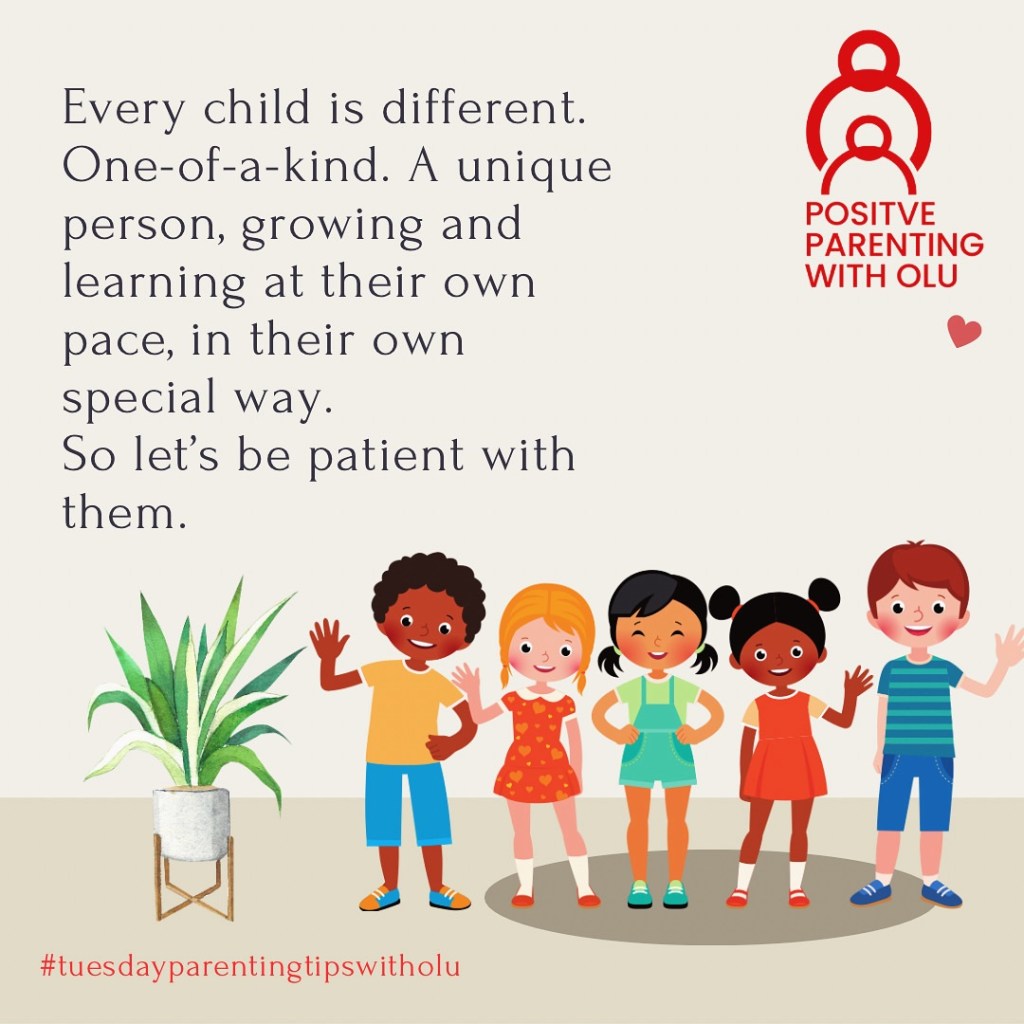
Every child is different and unique in their own way. So let’s try to be more gentle with the ‘slow ones’.
The child that takes time to play with other people, the sensitive ones that loves to observes first in a new environment before she feels comfortable. They’re going to be fine, they just want to do things at their own pace 😃.
Instead of shouting at them or pushing them to join in, maybe try to give them a chance first. They may surprise you.
And please dear parents, stop comparing them to other kids or their siblings.
Remember we are all different and we are all special in our own way.
Your children are fearfully and wonderfully made by God 🥰❤️
Thanks for reading through and happy parenting ❤️❤️🥰 WHEN WE KNOW BETTER WE MUST FO BETTER!











 Positive Parenting With Olu