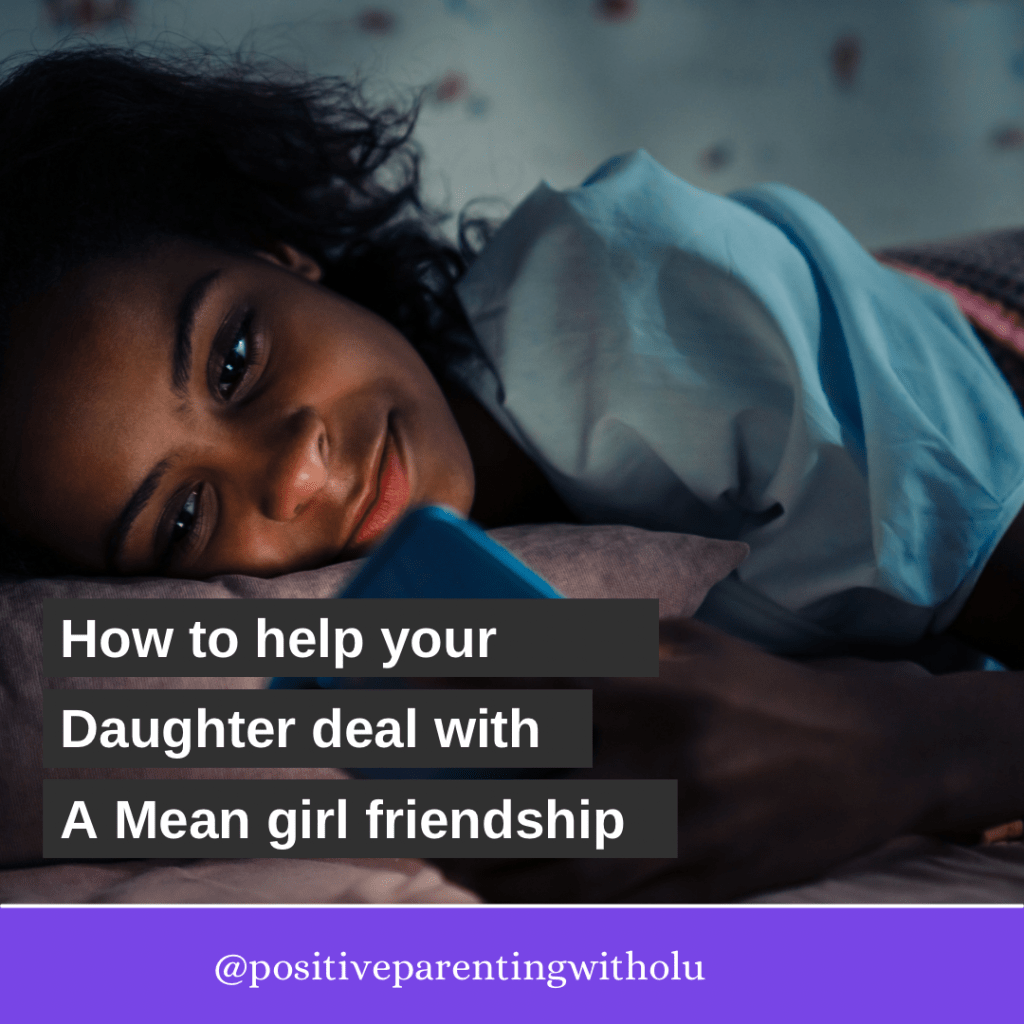
How to Help Your Daughter Navigate Mean Girl Friendships

Navigating the social dynamics of childhood and adolescence can be tricky, especially when it comes to mean girl behavior. As parents, we want to empower our daughters to handle these situations with confidence and kindness while protecting their mental well-being. Here’s a guide to helping your daughter deal with mean girl friendships.  

1. Create a Safe Space to Talk**

Encourage open communication by creating an environment where your daughter feels safe sharing her thoughts and experiences. Ask open-ended questions like:  

– “How are things going with your friends at school?”  

– “Have you noticed any changes in your friendships lately?”  

Listen attentively without interrupting or immediately offering solutions. Your understanding and support will make her feel valued and heard.  

*2. Teach Her to Recognize Toxic Behavior**  

Help your daughter identify what healthy and unhealthy friendships look like. Examples of toxic behaviors include:  

– Exclusion or ignoring her.  

– Gossiping or spreading rumors.  

– Insulting or undermining her confidence.  

Explain that friendships should be built on respect, kindness, and trust.  

*3. Build Her Self-Confidence**  

Mean girl behavior often thrives on insecurity. Boost your daughter’s self-esteem by encouraging her strengths and passions. Whether it’s excelling in sports, arts, or academics, help her recognize her unique talents.  

Additionally, teach her to affirm herself with positive self-talk, such as, “I am kind, strong, and deserving of good friends.”  

4. Model Healthy Relationships**  

Children often learn how to handle relationships by observing their parents. Model healthy friendships and conflict resolution in your own life. Show her how to:  

– Set boundaries.  

– Resolve disagreements calmly and respectfully.  

– Choose relationships that uplift and encourage growth.  

*5. Teach Assertiveness, Not Aggression**  

Assertiveness is key when dealing with mean girl behavior. Teach your daughter to use confident body language, maintain eye contact, and speak firmly yet politely. For example:  

– “I don’t appreciate being left out. I’d like to be included.”  

– “It’s not okay to say that about me. Please stop.”  

Role-play these scenarios to help her practice responding calmly under pressure.  

6. Encourage Expanding Her Circle 

Sometimes, the best way to navigate a toxic friendship is to foster new, healthier connections. Encourage your daughter to join clubs, sports teams, or other activities where she can meet like-minded peers. Expanding her social circle can help her find friends who truly appreciate her for who she is.  

7. Help Her Understand It’s Not Her Fault**  

Mean girl behavior often stems from the insecurities or struggles of the person exhibiting it. Make sure your daughter knows that someone else’s actions are a reflection of them, not her. Reassure her that she is worthy of kindness and respect, no matter what.  

8. Know When to Step In**  

While it’s important to let your daughter handle some challenges on her own, there are times when adult intervention is necessary. If the behavior escalates into bullying or begins to affect her mental health, consider:  

– Speaking with her teacher or school counselor.  

– Seeking professional help from a therapist.  

– Encouraging school-wide programs on kindness and inclusion.  

Final Thoughts

Helping your daughter deal with mean girl friendships is not just about addressing the problem—it’s about equipping her with the tools she’ll need to build healthy relationships for life. With your guidance, she can learn to navigate these challenges with resilience, grace, and self-respect.  

*What strategies have worked for your family? Share your experiences in the comments below!* 

Olu ❤️
PRACTICAL TIPS ON HOW TO SUPPORT YOUR CHILD WITH THEIR LEARNING AT HOME

Happy new year guys, it’s that time of the year again! The kids are back to school. 

Today I would like to share some practical tips you can do at home to help your kids with their learning. 

Just like everything in life, it needs planning. I’m sure you remember this phrase “if you fail to plan you plan to fail” 

So let’s start this New Year/ School Term with preparation so that our kids can do well in school.

So here we go! 👇

Practical Steps to Support your child with Learning at Home

1. Establish a Routine

– Set a regular schedule for learning activities, including specific times for reading, writing, and play.  

– Include short, focused sessions (10–15 minutes) to match their attention span.  

2. Create a Dedicated Learning Space

– Set up a quiet, organized area with a small desk or table, comfortable seating, and supplies like pencils, crayons, and paper.  

– Keep distractions (TV, toys) to a minimum during learning time.  

3. Make Learning Fun and Interactive

– Use games to teach concepts, such as board games for counting or memory games for problem-solving.  

– Incorporate hands-on activities like building with blocks, crafting, or cooking to teach math and science.  

4. Support Reading Skills

– Read with your child daily and discuss the story to build comprehension.  

– Choose books appropriate for their level and interests to make reading enjoyable.  

– Play phonics games to strengthen letter recognition and sounds.  

5. Encourage Writing Practice

– Provide fun prompts to spark their creativity, such as writing about their favorite animal or a recent trip.  

– Practice handwriting using lined paper or printable worksheets.  

– Encourage them to write shopping lists, greeting cards, or simple letters to family members.  

6. Incorporate Play-Based Learning

– Use toys and pretend play to teach concepts like shapes, colors, and storytelling.  

– Explore educational apps or online resources designed for young learners.  

7. Teach Math Through Everyday Activities  

– Count objects together, such as toys or snacks.  

– Practice basic addition and subtraction during daily tasks, like setting the table.  

– Use puzzles or building blocks to develop problem-solving skills.  

8. Foster Creativity  

– Provide materials like markers, paints, and paper for drawing or painting.  

– Encourage imaginative play, such as dressing up or creating stories with toys.  

9. Build Emotional Resilience

– Celebrate small achievements to boost their confidence.  

– Encourage a growth mindset by reminding them that mistakes help them learn.  

– Practice patience and provide support when they feel frustrated.  

10. Be Actively Involved

– Sit with them during activities to provide guidance and encouragement.  

– Ask open-ended questions about what they’re learning to deepen their understanding.  

– Stay in touch with their teacher for tips and updates on their progress.  

11. Keep Activities Short and Engaging

– Alternate between active and quiet tasks to maintain interest.  

– Offer frequent breaks and time to move around or play.  

12. Use Real-World Examples

– Take them on nature walks to discuss plants, animals, or weather.  

– Use cooking to teach measuring and following instructions.  

– Explore their surroundings to teach concepts like directions, maps, or community helpers.  

13. Limit Screen Time Wisely

– Choose educational programs or apps tailored for their age group.  

– Balance screen use with offline activities, such as reading or outdoor play.  

By incorporating these practical steps, you can create a nurturing and effective learning environment tailored to your child’s needs and interests.  

Ms Olu

Brighter Bee Learning Centre

MONEY TALK WITH MY GRANDAUGHTER!

MONEY TALK WITH MY GRANDAUGHTER!

Here is a quick story of how I taught my six year old granddaughter about money. 

So this Christmas I had the opportunity of spending some time with my daughter and her family in Manchester.

 So during my visit my daughter asked me to have a money talk with my eldest granddaughter Athena.

Athena is a very intelligent little girl and always eager to learn new things!. She also loves dancing and enjoys singing with her little sister Theo.  I enjoyed watching them play together.

Here is how our conversation went:

Me: “Athena where does money come from? . 

Athena: From the bank

Me: What is money used for?

Athena: To buy things

Me: How does your mom get money to buy stuff for you and your little sister?

Athena: From her boss.

Me: Why does her boss give her money 

Athena: Because she does work for her boss.

I was blown away from her responses. She knows a little about money 💰 

Me: How can you earn money at home?

Athena: By doing some chores. 

After our money talk I asked her what she learnt from everything we talked about. 

Her responses made me so proud of her even more when she said, “Money is valuable” 

She said that money is valuable. Which I think was the best word to describe money. 

So here are the full gist about our money conversation and I hope it helps you out with your kids. 

MONEY TALK WITH MY GRANDDAUGHTER 

First thing I did was ask her to get her piggy bank. And we emptied all her money on the table. 

I only picked out £5 notes, and £20 notes and some coins from her piggy bank. 

Lay them on the table and I showed her a £5 note and asked her how much it was. She had a look and said 5 dollars and I corrected her. 

I told her that here in the UK our currency is called pounds (£)

I later told her to find £1 from the money on the table. Which she was able to after having a thorough look.  

We also spoke about appreciating her parents whenever they get her things and always say thank you. Because they have to work hard for their money. 

Now she knows that when she wants something special, she has to save for it and sometimes she has to wait a little. ( -Delay Gratification’- which I think it’s a great skill for kids to learn 

I also had a talk with my daughter on how to keep the money conversation going at home when I’m not there.

MONEY ADVICE I GAVE MY DAUGHTER TO TEACH MY GRANDDAUGHTER 

  1. Give her a piggy bank. Tell her that she can earn £1 if she cleans her room or helps around the kitchen. (This depends on you)
  1. When you go shopping, show her how much some things cost. And maybe give her £1 to get maybe a snack and ask her how much change would she have left after paying for the snack. 
  1. If Athena wants something like a toy or a book, ask her how she can earn the money to buy the toys. Help her save for it. Celebrate her achievement to encourage future saving.
  2. To pay her some money when she does some chores at home. 
  3. At the shop, to teach Athena how to shop around before making a purchase. By comparing prices and looking out for sales.
  1. She will also take her to the bank and explain how money gets into the bank and how she can get money from the bank.
  2. And then later she can open a savings account for her when she’s ready. 

So why I’m I sharing this with you?

I think as a parent you should start teaching your kids about the basics of personal finance at a very early age because it is a time when they are very curious and open to learning, and instilling good spending habits in a person early in life could very well help them avoid years of overspending and debt as adults!

Give it a go today! Sometimes children can surprise you with what they understand. 

Please share this post with other parents 🙏🏾😊

REMEMBER THAT WHEN WE KNOW BETTER WE MUST DO BETTER! 

Happy parenting and I hope this helps! 

And happy new year in advance 

Olu ❤️

WHAT I AM LEARNING FROM PARENTING MY YOUNG ADULT SON.

I am learning everyday on how to change my approach  from treating him like a child to nurturing  a supportive, respectful, and collaborative relationship.

This is hard for me at the beginning, but I am now learning everyday that my role is no longer to direct his life but to offer guidance when he asked.

So today I will be sharing my experience with you parenting my son with anyone who is raising a young adult child like me. 

Here are some tips on how you can navigate this new relationship: 

  1. Accept Your Evolving Role
  • Shift from authority to advisor: Recognize that your role is no longer to direct his life but to offer guidance when asked.
  • Respect his independence: Trust him to make his own decisions, even if they differ from what you might choose.
  • Celebrate his adulthood: Acknowledge and affirm his growth and maturity as he navigates life.
  1. Build a Relationship Based on Respect
  • Treat him as an equal: Speak to him with the same respect and consideration you would give a friend or colleague.
  • Ask for his input: Show that you value his opinions, whether it’s on family matters or broader topics.
  • Respect boundaries: Give him space to figure things out on his own without
  1. Offer Support Without Overstepping
  • Be a sounding board: Let him come to you for advice, but avoid offering unsolicited opinions unless it’s a matter of safety or urgency.
  • Encourage problem-solving: Ask, “How are you planning to handle this?” instead of immediately stepping in to solve problems.
  • Support, don’t rescue: Be there for emotional and moral support, but let him handle the consequences of his choices

4. Communicate Openly

  • Prioritize listening: Let him share his thoughts without judgment or interruption.
  • Discuss expectations: If he’s living at home, have a conversation about shared responsibilities and boundaries.
  • Ask how you can help: Rather than assuming, ask directly what kind of support he’d appreciate.

5. Encourage Independence

  • Support life skills: Encourage him to take responsibility for things like budgeting, managing time, and making decisions.
  • Respect his timeline: Everyone grows at their own pace—don’t rush him into milestones like moving out or settling on a career.
  • Celebrate his wins: Acknowledge his achievements, no matter how small, to boost his confidence.

6. Set Healthy Boundaries

  • Balance involvement and space: Stay available but avoid being overly involved in his daily life.
  • Discuss mutual expectations: If he’s living at home, agree on boundaries like curfews, contributions to the household, or privacy.
  • Take care of yourself: Focus on your own goals and well-being, ensuring your role as a parent doesn’t overshadow your life.

7. Foster Emotional Connection

  • Stay curious about his life: Ask about his work, studies, or friendships without prying.
  • Show appreciation: Let him know you’re proud of him and love him unconditionally.
  • Build shared experiences: Spend time together doing things you both enjoy to strengthen your bond.

8. Let Go of Control

  • Trust his judgment: Even if you don’t agree with all his decisions, trust that he’ll learn from his experiences.
  • Accept mistakes: Understand that making mistakes is part of growth and avoid saying, “I told you so.”
  • Resist the urge to micromanage: Offer guidance only when asked or when necessary.

In Conclusion: 

Parenting an adult child is about evolving from a hands-on role to becoming a supportive, trusting partner in their journey. Embrace the shift, and your relationship will grow stronger as you both navigate this new stage.

Happy parenting ❤️❤️

Olu

TEACH YOUR CHILD GRATIFICATION. 

We all want the best for our kids. 

It’s really common for children to want something right now and not have to wait for it. 

However, as they say, the future belongs to those who wait. 

Research have shown that the ability to delay gratification is really important skills to teach children

Children need to learn to persevere and work hard to get whatever they want in life

So today I am going to share some ways you can teach your child gratification. 

Don’t give your child everything they asked for, teach them to wait!  

For example; Let’s say your child wants you to buy them a phone. You can say to them if you want a phone you have to save money for it. It’s not that you can’t afford to get them a phone. It’s just you teaching them the importance of delay gratification.  This skill is an important skill that will benefit them in the future.

Here is another example; Let’s say  your child wants you to get them a particular toy, you can say to them you will get them the toys in two weeks time.  Ask them to wait for it. But please make sure you keep your promise. 

Also, as parents, we need to lead by example, it’s not what we teach our kids, it’s how they see us behave

So if you want to teach your child not to buy an impulse, then they have to see you do the same.

Kids have to see you do whatever you want them to do.

In addition, if parents don’t keep promises, kids are less likely to wait for rewards. So please make sure you keep your promise to them at all times. 

The bottom line is to always tell kids the truth. Teach them the benefit of waiting when they are young. And reward them when they do wait. 

May God help us all in our parenting journey.

WHEN WE KNOW BETTER WE MUST DO BETTER

Happy parenting ❤️

Ms Olu

@positiveparentingwitholu

TEACH YOUR CHILD HOW TO HANDLE THEIR EMOTIONS BEFORE IT’S TOO LATE!

So the other day I read about an incident in a local school that involved a black 13 year old and a girl.

 I don’t know the full story or the back story. 

But the school claimed the boy was  ‘trouble’ and he was always causing problems in school and eventually he was expelled from the school.

This was very sad because this boy had been let down by the people who were supposed to help him! What do you think his future will look like?

It is not the first time I have seen this happening in schools. Schools are so easy to label our boys!

But also I still believe we parents are responsible for teaching our children how to manage their emotions 

I remember when My Son was in secondary school too and I was called in to pick him up because he was in a fight with another boy.

My Son is a very quiet boy and he’s always telling me about this particular boy who is always picking on him for no reason. So that day the boy picked on him so he fought back. Which was wrong. I alway tell him that violence does not solve anything.

So that was the day I started teaching him the techniques of managing his emotions!

So today’s post is for any parents who have a son or a daughter who can’t control his or her emotions and always gets in trouble. 

5 WAYS TO TEACH YOUR SON HOW TO MANAGE THEIR EMOTIONS

  1. SHOW THEM BY EXAMPLE (children always copy us) So how do you manage your own emotions when you are angry? Do you lash out or shout at them when you are angry (They are watching and they will think that’s normal and they will do the same thing when they are angry too 😊) So let’s learn how to regulate our own emotions first and our children will learn from us how to regulate their own emotions! (remember we are their first teacher) If parents don’t model balanced emotions and coping skills, it can be difficult for children to develop them. 
  2. Try to show empathy and understand what they are going through. (It helps you stop and think about what you may not be seeing)
  3. You can also discuss your own emotions and how you manage them.
  4.  Talk to your child about emotions. Let them know that we all experience different feelings, and it’s normal and it’s how we manage them that’s important. Use storybooks, songs or games to make it fun. ( You can buy my book about managing emotions on Amazon: – “LADI MOOD ADVENTURE”

My final thoughts: 

We are all emotional beings! And it’s ok to have big emotions, It is how we handle our emotions that makes the difference. 

A lot of our young men are suffering because they don’t know how to manage emotions outside of violence. 

So dear parents it’s our responsibility to teach our kids how to manage their emotions from a young age. 

Because I believe so much on this topic I wrote 2 books on it. One for kids and one for Teenagers. I will let you know when it’s available to purchase on Amazon 

Next week I will talk more about each of these tips. Stay tuned.…

WHEN WE KNOW BETTER WE MUST DO BETTER 🙏❤️❤️

Happy parenting 

Olu ❤️

DEAR YEAR 11, PREPARING FOR GCSEs (Academic Success Tips)

Hello parents, today’s post is for any parents that have teenagers in Year 11. 

Please try your best to encourage them to study hard and smart this year! 

This year is very extremely crucial for them because they will be sitting for their GCSEs in a few months.

To all our Year 11 students, best of luck this year :

Dear Year 11 Please read this post carefully and apply the steps below, Save it for future reference (if you have friends in Year 11 screenshot this and send it to them) 

For Academic Success: You Must Do The Following:: 

1. Daily Study Routine 

   Establish a regular study schedule. Instead of cramming before tests, try studying for 30 minutes to an hour each day. Breaking it up like this helps information stick better and reduces stress.

2. Time Management Skills

   Use tools like planners, to-do lists, or apps to organize your tasks. Start each day by planning out what you need to do, breaking big assignments into smaller steps.

3. Focus Techniques 

   Try methods like the Pomodoro Technique, where you study for 25 minutes and then take a 5-minute break. This can help you stay focused and avoid burnout.

4. Limiting Distractions  

   Find a quiet place, put your phone on “Do Not Disturb,” or use apps that block distracting sites. Setting boundaries with your devices can make studying easier and quicker.

Dear Teens, if you want to have good grades in your next GCSE exam, then you must study smart (it’s as simple as that )

REMEMBER YOU ARE RESPONSIBLE FOR YOUR LIFE (Don’t wait for life to happen, take charge of your life and build the future you want for yourself) 

Your future self will thank you later!

Best of luck on your Mocks this week! 

To all our Year 11 students, best of luck this year:

If you are struggling with any subjects we can help you. I am a private tutor and we support students with their learning.

Send me a DM today!

Ms Olu

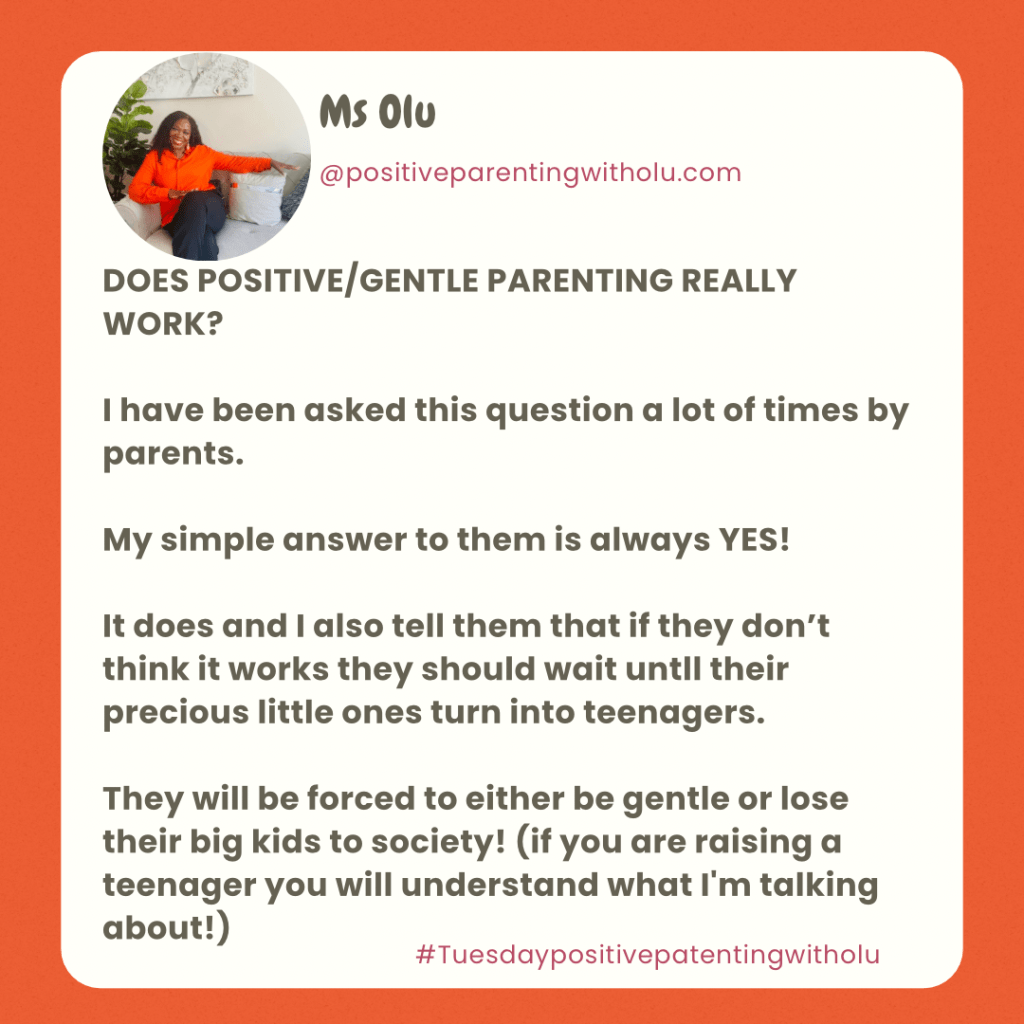
DOES POSITIVE/GENTLE PARENTING REALLY WORK?

I have been asked this question a lot of times by parents.

My simple answer to them is always YES! 

It does and I also tell them that if they don’t think it works they should wait until their precious little ones turn into teenagers. 😊

They will be forced to either be gentle or lose their big kids to society! (if you are raising a teenager you will understand what I’m talking about!)

As a teacher, mother and grandma, I have witnessed many moms, and friends circle with this positive mindset raising loving, kind and respectful children with whom they share close relationships as adults who are now in happy relationships and raising their children. 

So one thing I would like all parents of young children reading this is to always remember, that they are not raising kids, they are raising adults. 

 Positive upbringing results in positive children/adults. That’s not to say that a child/teenager will not stray, but love will always bring them back home.

I can’t stress this enough!  Children learn what they live! ALL DAY LONG!!

So be careful how you treat or speak to people when your kids are around! THEY ARE WATCHING YOU

Dear parents, PLEASE find opportunities each day to help them grow and learn to be the best adults they can be by the way you live! 

Raising your kids with kindness, love and respect will pay off later.  Trust me! 

Always treat your kids with kindness. BECAUSE THEY ARE YOUR BIGGEST BLESSINGS 

And this is one of the reasons that I make KINDNESS a BIG part of our classroom management. 

My kids know that they have to be nice and say kind words to each other when they come to lessons.

REMEMBER WHEN WE KNOW BETTER WE MUST DO BETTER!

Happy parenting. 😊❤️

MY CHILD DID NOT “PASS” THE 11 PLUS EXAMS! (What Now?) 

HANDLING 11 PLUS DISAPPOINTMENT!  

I have been receiving calls from parents about the 11-plus exam results. 

Some are good, some not so good. So today I decided to talk to those parents whose kids didn’t pass the exam. 

I believe that if they didn’t get in it’s just because the school wasn’t right for them, not they are not right for the school, things happen for a reason.

Dear parents, you know your child is bright, kind, confident and more than enough! 

You know they will be amazing wherever they go. Please don’t allow an exam to take that away from your child! 

All you need to do now is to find a good school for them.

Please do not allow your child to feel like she isn’t good enough, they can do amazing things in life, no matter what school they go to!

Please remember this,  A bright child will do well anywhere! 

There are other ways of being successful, grammar school isn’t the only way. 

In addition, dear parents, this is not the time to be too hard on them. Remember they are already disappointed in themselves! 

So allow them to work through their emotions. It’s ok for them to be upset. They are  disappointed. Just support them and encourage them. They will be fine. 

Let them know that- . People who go to grammar schools are not the only ones who succeed in life.

ABOUT CHOOSING THE RIGHT SECONDARY SCHOOL

There are lots of good schools around. So please do lots of research before you choose a school for them.

 I hope they get into a good secondary school. 

Best of luck! 

Just thought I should share

Ms Olu ❤️

HOW DO YOU DEAL WITH YOUR TEENAGER WHEN THEY DON’T LISTEN TO YOU ANYMORE AND THINK THEY KNOW EVERYTHING ABOUT LIFE? 

I’m going to be completely honest here. When my son turned 16 that was when he gave me a lot of challenges. A lot.

 But what I’ve learned is that you have to tell them right from wrong, let them make some decisions themselves even if they’re bad decisions, explain the consequences of those decisions and stay CLOSE. 

Let them know you are there – no matter what. Don’t give up on your kids. EVER. Don’t tell them to figure it out on their own. And I say this with what I know now!

When my son turned 17 I  noticed he had started following the wrong crowd. I didn’t change him, but I made sure that he did his chores and followed the house rules. I was very worried for him then but I didn’t listen to anyone – anyone who gave me advice. I did what my gut told me to do. Moms have to be there even when it hurts when they don’t know what to do – just be there.

Now my son who is now 20 is one of the most hardworking and disciplined people I have ever known. He doesn’t ask me for anything he looks after himself. He is very independent. The other day he told me that his boss told him he is one of the best employees and that he is an asset to their company.

So my advice for any parents raising teens is to:

  •  Try to be less parental and a bit friendlier.
  • Try listening to them without responding negatively. Talk to them positively. 
  • And stop telling everyone about their behavior. 
  • If you are going to talk to people about them, say positive things about them only.

When our kids turn to teenagers as parents that is when we should be more careful and mindful of how we interact with them. I’m not saying you should take nonsense from them. But it takes two to tango. 

I have learnt to pick your battles. And stop reacting to everything my son does even now that he is a young adult. 

Be more laid back in your interactions and with demands. They will come around. 

Happy parenting ❤️

I hope this helps 🙏🏾❤️❤️❤️

WHEN WE KNOW BETTER WE MUST DO BETTER