DEAR MOM, CONNECT WITH YOUR TEENS (Day 2)

Hello moms, a few days ago I shared some of the questions your daughters really want to know. 

Do you like me?

That also seems like such a laughable question, but you’d be amazed at how many girls tell me they truly believe their mom doesn’t enjoy their company. 

As parents who are trying to keep our teenagers safe and guide them toward making good choices, sometimes we are guilty of focusing on everything that could go wrong at the expense of accepting what is going right. 

Study shows that – Between teachers, coaches and parents, the average teenager is scolded, redirected or corrected approximately 50 times per day! 

✅ Your daughter is eager to know what you enjoy about her personality and what talents you admire in her.

 ✅ She wants to know all the ways she reminds you of your younger self, or of your own mother. 

✅ She wants to know all of the hopes you have for her, without the weight of making a mistake and disappointing you. 

✅ Remember when she was 3 years old and every little accomplishment –from the simplest artwork to tying a shoe — was praised as amazing? She just wants a little taste of that again.

Dear parents Let’s do better 

To be continued….

Thanks 🙏🏾 

Olu ❤️❤️❤️

3 Questions your Teenage Daughter Wants to Ask You

I’m passionate about working with children, I enjoyed working with them and I love them and sometimes some of them are misunderstood.

No child is born bad! 

Today,  I’m going to share some of the questions your daughters want answers to … 

Pre-teens and Teenage girls feel vulnerable, scared and at times unlovable.

I know they can also be difficult, self-centered and impossible. 

As moms it’s our job to see past the eye-rolling and sighing to figure out what is really on their minds. 

They are craving a more connected relationship with you, but what does that really mean? 

After working with lots of girls over the years, 

I have learned that what they really crave from their moms is an answer to these 3 question.

Do you really know me?

It seems a little silly, I know. Of course you know your daughter. But the question is really deeper than that. She is looking for evidence that you want to know who she is and what she cares about. She wants to know: Do you know what I like to do for fun? Do you know who my friends are? Do you know who my crush is? Do you know what kind of music I like?

And more importantly, do you know what I dream about? Do you know what kind of life I want for myself? Do you know what I’m afraid of? Do you know what I worry about?

One of our deepest, most basic human needs is the need for Love and Belonging. 

Your daughter is craving a connection with you that reassures her that you see her, you hear her and you “get” her.

 When was the last time you had a conversation with her about her future that didn’t involve getting into college and her grades?

 When was the last time you asked her about her favorite artist and what she loves about her instead of just asking her to turn the music down?

Think on this today and I will see you tomorrow 

Please dear parent let’s do better 🙏🏾😊

To be continued tomorrow …

Olu ❤️❤️❤️

#childrenareawesome

#girlsrock

#teenagegirlslovetheirmom

#doyouknowyourdaugther

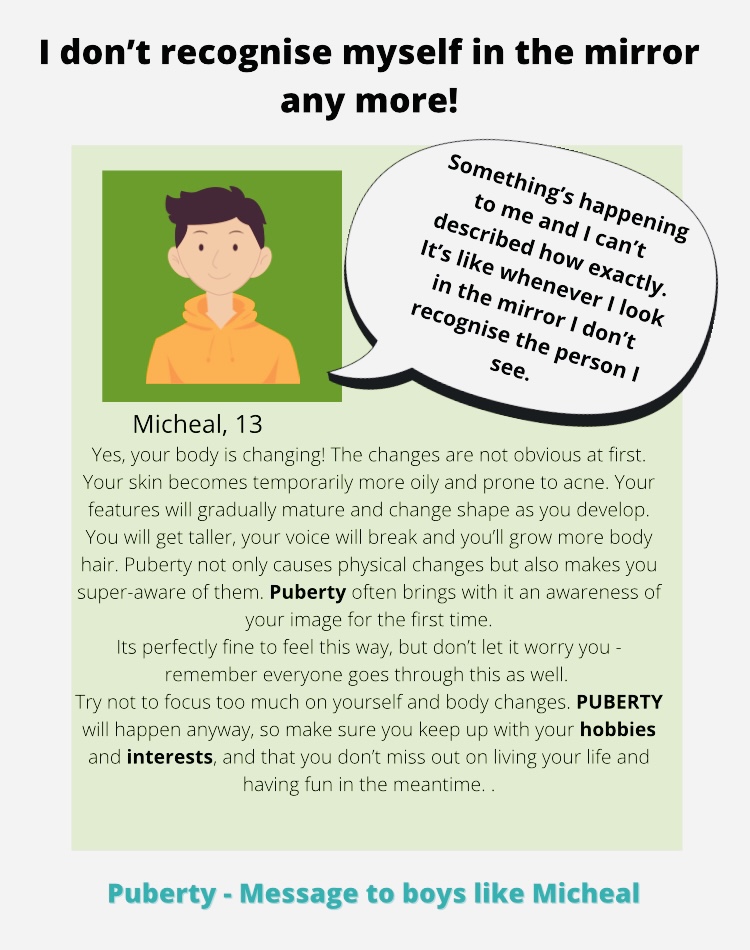
BOYS AND THEIR BODY

Dear parents, do you have a son between the age 10 and 15? 

Have you noticed that the clothes that you got a few weeks ago don’t fit?

Are they concerned about how they look?

Do you notice that they’re always angry?

They’re probably going through puberty. 

Dear parents, It’s good to know about the changes before they happened.

So, today I’m going to share 5 top things a boy can expect when going through puberty.

  1. Your son will go through a growth spurt, it’s a time when their body grows tall so fast. So during puberty your son should grow taller. Their feet will grow too. It’s normal 😊
  2. They will start having some sensation down there and sometimes have wet dreams. It’s normal. If your son told you about this let them know that it’s ok and that they’re going through puberty. 
  3. Another thing that comes with puberty is acne or pimples. Tell them not to touch or squeeze the acne. The good thing about acne is that it usually disappears after adolescence.
  4. One of the signs of puberty is hair growing in places that it didn’t grow before. 
  5. They will sweat a lot and smell. This is normal, It’s their hormones at work. The best thing to do is to make sure they have a thorough bath daily. Get them a deodorant or antiperspirant for their armpit and dettol soap for bathing. It helps with my son when he was going through puberty 😊.  Their voices will change too. 

So when puberty hits your kids, their body will change a lot! They will experience new emotions, strange feelings and new brains.

So as parents when we educate ourselves on this subject we are going to be ready to deal with them when they start or if we don’t we will lose them and start having a power struggle with them.

By the way, I have just written a book about Girl’s puberty.

If you have a daughter and you want her to be prepared for puberty and everything about girls stuffs, then buy my book! (DEAR GIRL IT’S ALL ABOUT YOU) 

I know for some of us when growing up, our parents did not tell us about puberty or menstruation. When it came we just got on with it.  😄

But as a 21 century parents raising children we should do better. 

Knowledge is power!

The girl book about puberty will be available on Amazon on Friday 

Just go on Amazon and type my name on the search bar -OLUFUNKE AKINNIYI and you will see my books

OLU

Have a lovely day today guys 🥰❤️❤️

#girlstalk

#boytalk

#puberty

#beintentional

#positiveparentingwitholu

#positiveparenting

#parentingtips

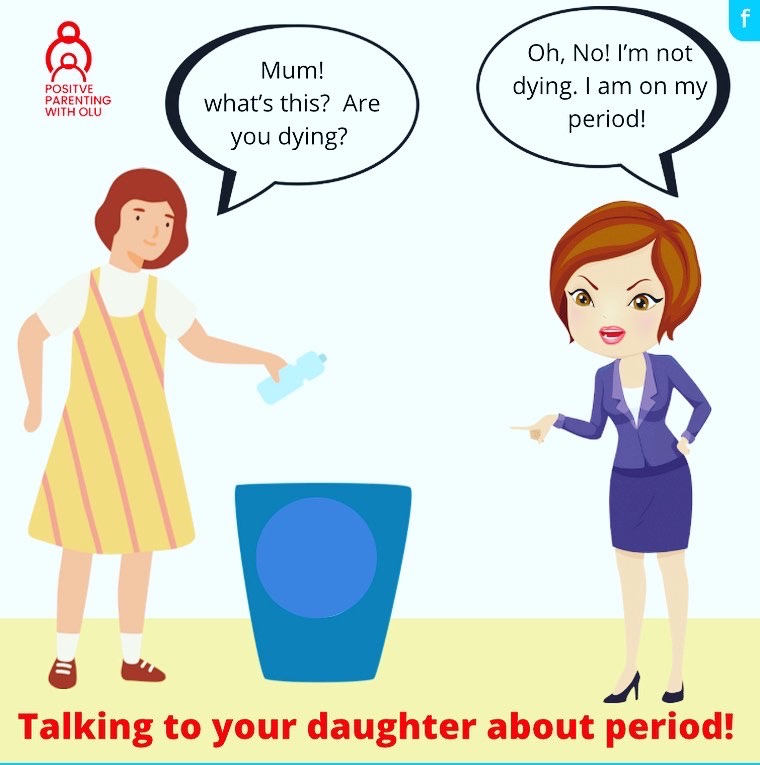
TALKING TO YOUR DAUGHTER ABOUT PERIOD!

DO YOU HAVE A 10 YEAR OLD DAUGHTER? 

If you have a 10 year old daughter and you haven’t spoken to them about their first periods yet. 

Then today’s post is for you.

Today I’m going to talk about supporting your daughter with their first period. 

It’s important to talk to your daughters before they start their periods. 

Most parents always shy away from this topic.

If you don’t know what to say, you can just screenshot my post and send it to your daughter’s phone. 

It’s going to happen anyway, better to get them ready in the best manner.

_____________________________________

WHEN WILL I GET MY FIRST PERIOD?

Before you get your first period, you might notice changes in your:

Nipples/breasts

Pubic hair

Body shape 

Fluid in your underwear

The most important thing to remember is that your body is unique. There is no exact “right” time for anything to happen. 

Every healthy body has its own pattern and timing. 

WHEN PERIOD STARTS 

There are a couple of clues as to when your period starts. It will probably be 2 to 3 years when your breast begins to grow. And a few months before your period starts you might get some more fluid leaking out from  your vaginal. Period usually starts sometime between the ages of 10 and 15. But not always 

PERIOD PAIN

Some women get aches below their tummy during and at the start of their period. 

Menstrual cramps happen because of contractions in the uterus, or womb, which is a muscle.

HOW CAN I STOP PERIOD PAIN? 

  • Exercise regularly. Physical activity, helps ease menstrual cramps for some women.
  • Use heat. Soaking in a hot bath or using a heating pad, hot water bottle or heat patch on your lower abdomen might ease menstrual cramps.
  • Try dietary supplements, such as Omega -3 and Vitamin E

PMS

Some people feel bloated, tired and low for a few days before their period. This is known as PMS (Premenstrual syndrome) And it’s probably caused by changing hormones. When this happens is best you try eating healthy food throughout the day and getting some exercise and rest. 

COPING WITH PERIOD

Having periods is a normal and healthy part of growing up. A lot of people have no pro them with them at all. On the other hand your hormones are going up and down. 

Dear girl, you still waiting to get your period? Try not to stress out about it too much. 

To be continued….

#girls

#firstperiod

#copingwithperiod

#menstrualtips

#momslife

#girlsmum

#positiveparentingwitholu

TALKING ABOUT PUBERTY 

Talking about puberty can be so awkward! 

What do you say? 

Where do you start? 

How do you get your tween or teen to open up?

These are some of the questions I get asked by parents. 

I’ve had students come up to me after class and said, “Ms Olu, I’ve got this question. But I can’t ask my mum.” And I say, why? Why do you feel like you can’t ask your mum? “Because well, she might think I’m rude.” 

I think the earlier we start talking to them the better. 

If we miss it, it may become difficult to get them to listen later when they’re already going through it. 

And by then you may start wondering,  what’s wrong with my daughter, what is she behaving like this and that. 

So the earlier you start the talk the better, so that when the mood swings and the body odor arrives you and your child will be ready .

START THE TALK EARLY! 

Kids see and hear a lot about sex and relationships on TV and online. 

By the time they near puberty, they may be familiar with some of the ideas. 

Is your job as parents to talk to your children about puberty because not all this other information is reliable.

Don’t wait for your kids to come to you with questions about their changing body.

Some girls start puberty at 8 years old, and some boys do by 9.

 So you may need to start these talks earlier than you think. 

Discuss the physical and emotional changes that come with puberty before they begin.

Normally, puberty starts in girls when they’re between 8 and 14 years old. 

With girls, parents should talk about menstruation before their daughters start their periods. 

If they don’t know what’s happening, girls can be scared when they see blood coming out from them.

Most girls get their first period when they’re 11 or 13 years old, which is about 2 or 2½ years after they begin puberty. But some get their periods as early as age 9, while others get it as late as age 16.

In boys, puberty normally starts when they’re 9 to 15 years. Some boys begin going through puberty a little later than girls, usually around age 10 or 11.

‼️EXPLAIN TO YOUR SON/ DAUGHTER WHAT PUBERTY IS 

✅Let her know that puberty is a normal part of growing up. 

✅You can say things like, – ‘puberty is the time in your life that you will start to grow and change to adulthood’. 

✅Let her know that her body will go through lots of changes. 

✅Explain to her that it can take 3 or 5 years to go through it.

WHAT SHOULD I SAY TO MY DAUGHTER ABOUT MENSTRUATION. 

✅ Look for teachable moments. Don’t make it sound like a lecture. And it doesn’t have to be a long conversation 😆

For example: when a tampon or pad commercial comes on TV 

You can say, have you ever heard of tampons or pads before? 

Ask her if she knows what they are used for. 

If she said no, then explain to her what it was and why she needs to know.

✅You can get a pad and just show her how to use it. 

✅ Talk to her about the changes in her body. (Breast growing, getting pimples, having body odor etc…) 

✅ Talk to her about changes in her brain. Let her know that she may feel grouchy or moody for no reason. Let her know it’s normal and it won’t last forever. 

Keep the Talks Going

Let your child know that you’re available to talk 😊 

And if you’re still not comfortable talking to them, then 

get them some books on Puberty 😊

Have you started having the talk with your kids yet? 👇

To be continued….

Have a lovely day 🥰❤️❤️❤️❤️

Adolescence (Storm and Stress)

So I have come to the end of my first year of studying a degree course  in child psychology at the Open university.

I also met my deadline this time,  and I’m so proud of myself 🙌🙌🙌

And yes,  it’s a year already 😆 

My final paper was on Adolescence. 

So, in this month of May I’m going to be sharing a little bit about what I learnt about Adolescence and How To Support Them As A Parent . 

So if you’re a parent of a teenager or young adult you may want to stick around with me this month. 😀

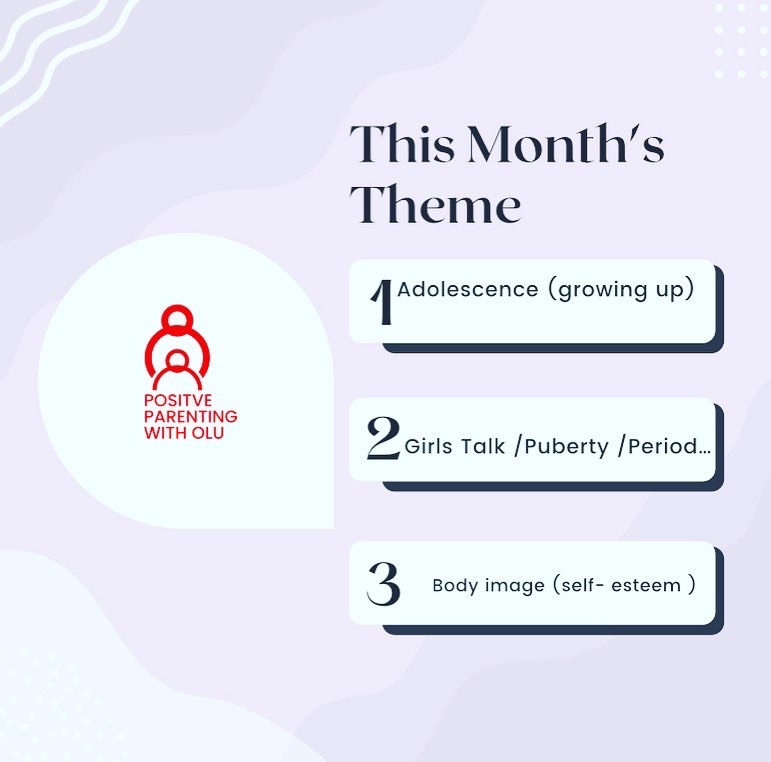
So our Theme for the month of May is going to be talking about: Growing Up (All about Adolescence, body changes and sex)

What is Adolescence? 

Adolescence is the phase of life between childhood and adulthood, from ages 10 to 19. 

It’s simply put as the phase of growing up (stages of development ) 

It’s the time and period when several things happen in a kid’s body that turns him or her into an adult. 

This time is not only marked by the physical, mentally, emotionally and psychological changes in the person. 

So if this is the meaning of adolescence, then what could puberty mean?

Puberty refers to the process of changes in the body 

The average ages that puberty occurs in children are between Ages 13 – 19 years.  

This is the time that most teens are not comfortable about themselves, the way they look and they feel unhappy with their body image. 

So why I’m I sharing  this with you? 

Here is why 👇

Because the teenage years are very crucial in everybody’s life. 

I have noticed that some of us parents are not talking to our children about personal stuff like this, maybe  because some of us don’t know how or we are just not bothered and we leave it to schools. 

Yes, most schools will educate your kids about this things, but as parents it’s our responsibility to make sure we do the same.

A lot of what we do in our adult life is actually incorporated in how we do things. 

So it make sense to prepare children and young people for that kind of situation that they are bound to encounter.  

To be continued next week …

Have an amazing week guys 

What do you think? Do you find it easy to talk to your children or teenagers about personal stuff? 👇👇👇

KINAESTHETIC OR HANDS ON LEARNER

HOW TO DISCOVER YOUR CHILDREN’S LEARNING STYLES (Part 5) 

Today’s post is our last post on this topic, if you’re new here you may want to go on my timeline to read my previous post on today’s topic. 

So today we are going to talk about how a Kinesthetic or Hand on learner learns using a scenario and maybe this will help you identify how your child learns.

KINAESTHETIC OR HANDS ON LEARNER

Let’s call our character Bimbo

Bimbo is a kinaesthetic learner, she has got a lot of energy. And she likes doing things. 

Lab and hands-on activities help her to understand certain ideas and topics. 

Sometimes she will review her work while she is walking around. 

She also likes to take breaks in order to release some of her energy on order to focus when she returns to study 

Please remember that children learn differently.

However, by getting to know your child’s learning styles and finding study methods that works for them they just might find themselves getting better results 

So what do you think, is your child a Kinetics learner? 👇

Have an amazing day 🥰🥰🥰

HOW TO DISCOVER YOUR CHILDREN’S LEARNING STYLES (Part 3 )

We are still on the topic of the importance of knowing your children’s learning styles.  

Today, we are going to talk about how an auditory learner learns using a scenario and maybe this will help you identify how your child learns.  

An auditory learner, learn by hearing and listening. They understand and remember things they heard.

This type of learner stores information by the way it sounds, and they have an easier time understanding spoken instructions than written ones.

Aisha is an auditory learner and she likes to study in the group and discuss it with others.

Sometimes she even reads her notes out loud, because it helps her to hear what she’s studying. 

In some classes, Aisha will record the lecture with her teacher’s permission of course 😊. So that she can go back and listen to it later. 

So what do you think, is your child an auditory learner like Aisha?

If your answer is yes, then maybe you can start incorporating today’s tips to support their learning at home.

To be continued… 

Thanks for reading through 🥰🤗

OLU ❤️❤️

May your week be sweet 🥰❤️❤️

Do you know your children’s learning styles? (Part 2)

HOW TO DISCOVER YOUR CHILDREN’S LEARNING STYLES.

Last week I talked about how to know your children learning styles 

If you’re new here you may want to go on my timeline to read some of my previous posts on parenting. 

Today’s post is for parents that are not sure how to help their kids at home with their learning.

Knowing Your Child’s Learning Style: Why Does It Matter?

Every child is unique and learns differently. It is important for parents to know their child’s learning style in order to help them succeed in school.

So, today we are going to talk about how a visual learner learn, using a scenario and maybe this will help you identify how your child learn 

OLA – 

As a visual learner, he finds it helpful to color code his notes. 

This method helps him organise the information and internalise it better. 

He also creates diagrams while studying, because he realizes this helps him better understand certain structures and ideas. 

Ola watches videos too finding it helpful for extra information 

So what do you think, is your child a visual learner like Ola? 

Next week I’m going to share more 😊

Have an amazing day 🥰🥰🥰

LEARNING STYLES

DO YOU KNOW YOUR CHILDREN’S LEARNING STYLES?

I used to worry a lot about how to help my son with his learning when he was in school.

Most times when he is preparing for exams, this boy will study and study and with all that studying he will still fail his test. Why? 🤷‍♀️

So I decided to start thinking of how to help him with his learning. 

I did some research and I found out that everybody learns differently. I should know that right? 😃

However in order to find the study method better for him, I had to know his learning style.

Through my research I discovered that there are 4 most common learning styles. 

So let’s use my son as an example;

My son told me, he is in class when his teacher is lecturing. He gets distracted easily, but when his teacher started using visuals, he said he finds it easier to focus and understand. 

I realise that he might be a visual learner and that  he understands things better when you show him how.  

So knowing this, I started implementing this method with him at home and his grades improved. 

I also use this method to support my students too.

So today I’m going to talk about the 4 most common writing styles. 

FOUR TYPES OF WRITING STYLES

  1. VISUAL – They learn by watching videos or learn best when you use an object to teach. 
  2. AUDITORY- They learn by Listening 
  3. READING AND WRITING – they learn by reading a text and writing what they’ve learnt down. (They may like journaling) 
  4. KINESTHETIC  or HANDS ON  (these are the kids that can’t sit still through a lesson. They have low attention span 

PLEASE REMEMBER THIS!

For most people one of these methods will work best, but note that it’s also possible for combinations of different styles to be effective. 

HOW DO YOU KNOW YOUR CHILDREN’S

 LEARNING STYLE 

Think about the following questions first👇

How do they learn?

Do they prefer watching over listening?

Or do they enjoy reading instead 

Or do they learn best by doing? 

Can they sit through a lesson or do they prefer taking breaks often?

So now that you have learnt the 4 basic learning styles – 

Are you going to use it?

Or do you know your child’s learning styles already? 👇

If you want more content like this one, ❤️❤️❤️❤️

To be continued..

Have a lovely day today guys 

Thanks

OLU 🥰❤️